
Bringing International Capital Closer to Indian Businesses.
GLOBAL CAPITAL. STRATEGIC STRUCTURING. LOCAL EXECUTION.
International capital can accelerate growth, expand market access and strengthen the financial architecture of a business.
XYZ Arrow provides transaction-oriented advisory support for companies, promoters, investors and institutions exploring Foreign Direct Investment (FDI), Foreign Portfolio Investment (FPI) and External Commercial Borrowings (ECB).
From identifying potentially relevant foreign investors and capital providers to evaluating transaction structures and coordinating the execution process, we help clients navigate the complexities of cross-border capital.
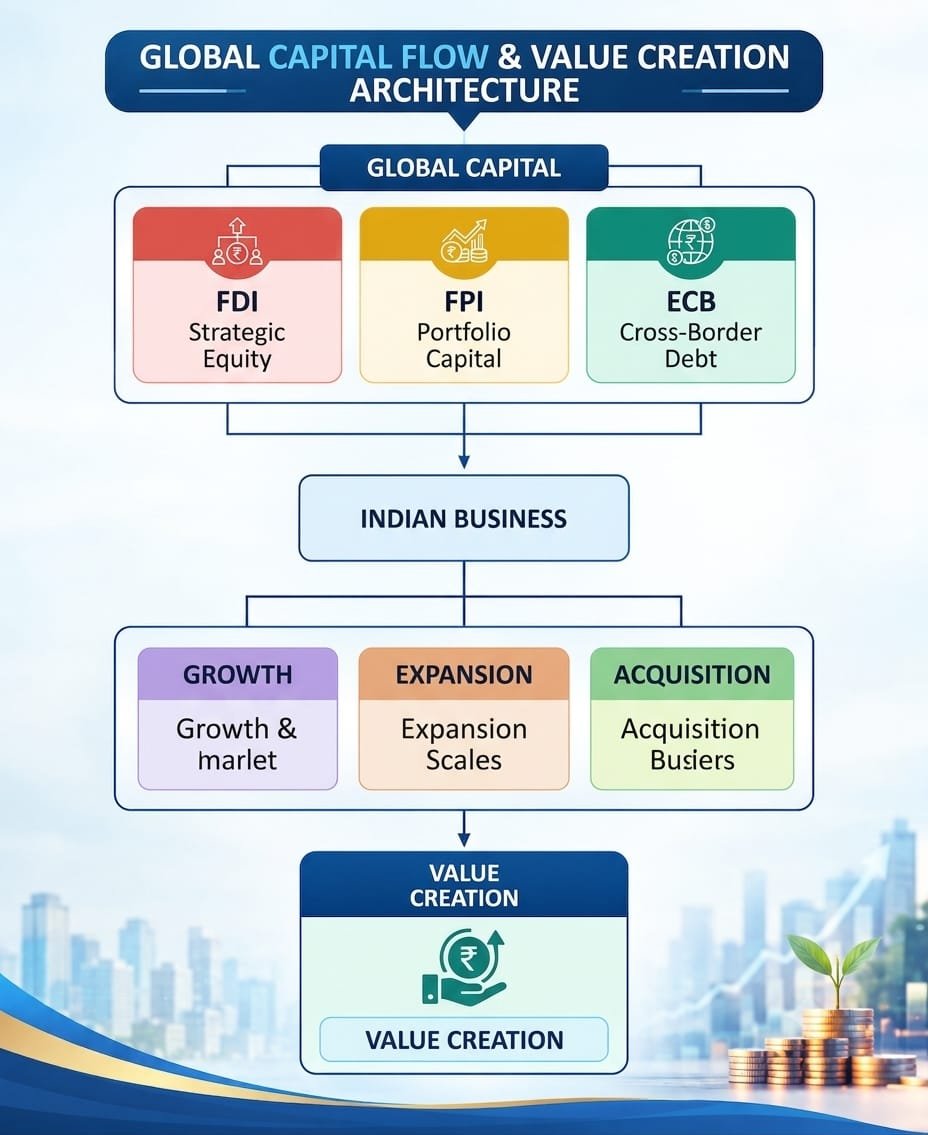
Choose the right capital architecture.
The best source of capital is not simply the one that can fund the transaction. It is the one aligned with your ownership, growth, risk, return and strategic objectives.
Important: The actual eligibility and permitted structure must be assessed against the rules applicable on the transaction date.

Foreign Direct Investment
Long-term strategic foreign capital for businesses seeking growth, expansion, technology, market access or strategic partnerships.
Foreign Portfolio Investment
Access to eligible foreign portfolio investors seeking exposure to Indian securities and investment opportunities, subject to applicable SEBI/RBI rules and eligibility requirements.

External Commercial Borrowings
Cross-border debt capital for eligible Indian entities, subject to the applicable RBI framework, eligible lender/borrower conditions, permitted end-use, maturity, pricing and reporting requirements.
Foreign Direct Investment (FDI)
The Basics Of Foreign Direct Investment
Foreign direct investment is very important for developing nations. In order to expand internationally, the organizations of such nations need foreign funding. Such funding allows these organizations to spread sales internationally. Moreover, with foreign direct investment, the developing nations get funding for the following:
- Infrastructure
- Energy
- Water
- Combating climate change effects
Types of Foreign Direct Investment
Horizontal direct investment: Here, the organization establishes and runs the same business type in the foreign nation as it does in its home nation. For example, A UK computer products provider purchasing a chain of computer products stores in France.
Vertical investment: Here, an organization, in another nation, purchases a complementary business organization. For example, a UK furniture manufacturer acquiring an interest in a foreign organization that provides it with wooden material.
Conglomerate investment: Here, an organization invests in a foreign organization which has no resemblance to its core operations. Usually, this happens as a joint venture since the home organization lacks experience.
Examples of Foreign Direct Investments
Methods of Foreign Direct Investment
Reinvesting profits from overseas operations, as well as intra-company loans to overseas subsidiaries, are also considered foreign direct investments.
Finally, there are multiple methods for a domestic investor to acquire voting power in a foreign company. Below are some examples:
- Acquiring voting stock in a foreign company
- Mergers and acquisitions
- Joint ventures with foreign corporations
- Starting a subsidiary of a domestic firm in a foreign country
Foreign Direct Investment In India
- The concept of FDI was broadly evolved during the economic crisis, which had happened in 1991. Due to which there were increased imports and reduced exports, resulting in investors pulling out their investments/funds, etc resulting in a trade deficit.
- To meet this economic crisis, the government implemented the policy of liberalization, which paved the way for increased FDIs in India.
- Most foreign companies invest in India to take advantage of relatively lower wages, increased manpower, and special investment privileges, such as excluded trade barriers, tax exemptions, Special Economic Zones (SEZs), etc.
- In 2015, the milestone was achieved by India by overtaking the United States of America and China in attracting more FDIs and becoming one of the preferred destinations for FDI.
- In India, FDI can be entered through two ways, they are
- Automatic Route
- Government route
Automatic Route
- In automatic route, the foreign investor or Non-Resident Indian (NRI) and the Indian company does not require any prior approval from the Reserve Bank of India (RBI) or the government of India, for the investment.
- The FDI policy of India is broadly classified as per what is allowed in this route
FDI policy: Sectors which fall under the complete Automatic route are
- Automobiles, Auto components, Agriculture and Animal husbandry, Airports (Greenfield and Brownfield), Air transport services (non-scheduled), Air transport services (Helicopter service and seaplane services).
- Broadcast Services (both the Up-linking and down-linking of TV channels), Broadcasting Carriage Services, and Biotechnology (Greenfield).
- Capital Goods, Cash & Carry Wholesale Trading Chemicals, Coal & Lignite, Construction Development, hospital construction, Credit Information entities.
- Duty-Free Shops, E-commerce Activities, Electronic equipment, Food Processing sector, Gems, and Jewellery.
- Industrial Parks, IT & BPM, Leather Industry, Manufacturing, Mining & Exploration of metals & non-metal ores, health care.
- Civil Aviation Services such as Maintenance and Repair Organizations, Petroleum and Natural gas, Plantation sector, Ports and Shipping, Railway Infrastructure development, Renewable Energy, pharmaceuticals.
- Textiles, Garments, Thermal Power generation, single-brand retail trade, Tourism, Hospitality, and White Label ATM Operations.
Government Route
- Under the government route, the foreign investor and the Indian company should get approval from the RBI or Indian government before the investment.
- Similarly, the FDI policy of India also categorized all the sectors, which are bound to obtain this approval.
- The approval body differs according to the nature of the sector and investment.
FDI policy: Sectors which require the approval of the government are
Up To 100% Of Government Approval:
- Mining works and mineral separation of titanium bearing minerals and ores.
- Food product retail trading.
- Printing & publishing of scientific magazines/journals/periodicals.
- Publication of facsimile edition of foreign newspapers.
- Satellite (both establishment and operations).
Beyond 49% Of Approval:
- Defence
- Air transport service (scheduled).
- Telecom sector
- Banking – private sector
- Private security agencies
- An investment made by foreign airlines
- Broadcasting services
- FM radio
- News and current affairs TV channels
Up To 26% Of Approval:
- Printing Media – Publishing of newspapers and periodicals dealing with news and current affairs.
- Printing Media – Publication of Indian editions of foreign magazines dealing with news and current affairs.
Other Approval %:
- Banking – public sector – (up to 20% of approval),
- Multi-Brand Product Retail Trading – (up to 51% approval).
- Pharmaceuticals (Brownfield) – (above 74% approval).
FDI policy: Sectors where FDI is Prohibited
There are certain sectors where the FDI is completely prohibited.
- Nidhi Company
- Investments made in chit funds.
- Energy generation (Atomic)
- Gambling or any similar business.
- Lottery business (private, government, online).
- Housing and real estate (apart from townships and commercial projects).
- Cigarettes and any similar tobacco industries.
- TDR standing for Transferable Development Rights
- Agriculture and plantation activities (despite exceptions like pisciculture, horticulture, fisheries, animal husbandry, tea plantations).
Benefits of Foreign Direct Investment in India
- FDI boosts the employment rate within the target country, as investors build new companies, which generates more jobs opportunities.
- FDI contributes to the development of human resources, i.e by training and sharing experiences, which would increase the education of the people.
- As a foreign investor, you can avail tax benefits like incentives, exemption, etc depending upon the sectors where you invest.
- The new technology and different types of equipment provided by the investor will increase the overall productivity of the target country.
- Furthermore, the FDI will allow resource transfer and exchange of knowledge and skills with the target country.
- One of the important advantages of FDI is that it generates more job opportunities and higher wages, and it directly increases the economic growth and national income of the target country.
Demerits of FDI
- hinder domestic investments and transfer control of domestic firms to foreign ones.
- risk political changes, exposing countries to foreign political influence.
- influence exchange rates.
- Influence interest rates.
- Overtake domestic industry if they cannot compete.
Checklist for FDI compliance
- Make sure the FDI funds are provided from the investors’ bank accounts.
- The purpose of the remittance along with customer information should be stated towards the investment in share capital.
- The company receiving the investment, by using the receipt of the remittance, can apply for Foreign Inward Remittance Certificates (FIRC) in the bank.
- FDI receipt to banker within 1 month of the receipt of remittance furnishing the copy of FIRC.
- Within 180 days from the receipt of remittance, allot the shares concerning the remittance received by the following methods
Get the share valuation report from any Chartered Accountant.
- If necessary, increase the share capital by complying with the rules and regulations of the company’s act.
- Obtain the certificate from the company secretary for the accomplishment of the compliance with the company act for FDI.
- Within 30 days of allotment of FDI, submit Part A of the Form FC-GPR to the banker by attaching the following documents.
Share valuation report obtained from the Chartered Accountant.
- Compliance certificate obtained from the Company Secretary.
- FIRC copies
- Mention the Annual returns of foreign liabilities and assets in Part B of the Form FC-GPR and submit to the Reserve Bank of India (RBI) & External Liabilities and Assets statistics Division of Mumbai before 15th July of every year along with the audit reports of the company.
Procedure for approval of FDI in India
- Automatic route: The FDI sector permitted under the automatic route does not require any prior permission from Indian government or Reserve Bank of India. Within 1 month, the investors need to inform the regional office. Similarly, submit the required documents with the same regional office, within 30 days of the issue of shares to the foreign investors.
- Government route: Automatic route not applicable! It is necessary to obtain prior approval from the government of India and it is considered by the Foreign Investment Promotion Board (FIPB). FDI proposal, except for Non Resident Indians and 100% Export Oriented Units (EOU) must be submitted to the FIPB, Department of Economic Affairs (DEA), and Ministry of Finance. Similarly, the application for NRI and EOU should be submitted to the Secretariat of Industrial Assistance (SIA) unit in the Department of Industrial Policy & Promotion (DIPP).
Approval Procedure:
- Submit the proposal and appropriate document required in the Foreign Investment Facilitation Portal.
- The DIPP will assign the case to the concerned ministry within 2 -3 days.
- If the documents are digitally signed, then the submission of physical copies to the concerned department is not required.
- The applications, which are not digitally signed, will be intimated through online communication to submit the signed physical copy by the competent authority.
- Once the application is received, within 2 days, it will be circulated online to the RBI for review from FEMA.
- All FDI proposals are shared with the Ministry of External Affairs (MEA) and the Department of Revenue for Record (DoR). if any changes are mentioned by these departments then it will be directly shared with the concerned ministry, which is designated to decide the proposal
- The proposals are analyzed within 1 week and if any further information is required, it will be asked for.
- Once all the required information is obtained, the competent authority is required to deliver the decision within the subsequent two weeks.
- The approval or rejection of the proposal is intimated to the applicant online.
- If the total foreign equity fund is above Rs 5000 crore, then the appropriate authority is subjected to place the same to the Cabinet Committee on Economic Affairs (CCEA), for reference.
Documents Required for FDI in India
- For any FDI to be made within India, certain documents are required to be submitted along with proposals. Apart from the documents mentioned below, certain documents can be required by concerned departments depending upon the sector in which investment is made.
- The names, addresses, and ID proof of all foreign partners of the investor company.
- The following documents are to be submitted by both the Investee & Investor Companies Certificate of Company Incorporation.
- Memorandum of Association (MOA)
- Resolution made in the Board meeting.
- Audited financial statements of the last financial year
- Article of Association (AOA)
- Both the pre-and post-investment shareholding pattern of the investee company.
- In the case of existing joint ventures, a copy of the joint venture agreement/Shareholders’ agreement/ technology transfer/trademark/brand assignment agreement should be submitted.
- An affidavit stating that all the information provided in hard copy and online is similar and correct.
- Copy of downstream intimation.
- Copy of applicable past FIPB/SIA/RBI approvals, which is connected with the current proposal.
- Foreign Inward Remittance Certificate (FIRC) should be submitted, in case the investment has already been made by the foreign entity.
- Share valuation certificate as approved by a certified Chartered Accountant.
What is Foreign Portfolio Investment(FPI/FII)?
Understanding Foreign Institutional Investors
- In India, FII is used for overseas entities that invest in the Indian financial markets. FIIs play a significant role in any economy. They are typically big companies and organisations such as banks, mutual fund houses, and other such entities that invest massive sums of money in the Indian investment market. The presence of FIIs in a stock market, and the securities they purchase, help the markets move upward. As such, they can strongly influence the total cash inflow coming into an economy.
- These investors usually include hedge funds, mutual funds, insurance companies and investment banks among others. FIIs generally hold equity positions in foreign financial markets. Due to this, the companies invested in by FIIs generally have improved capital structures due to healthy inflow of funds. Thus, FIIs facilitate financial innovation and growth in capital markets.
- The entry of an FII can cause a drastic swing in domestic financial markets. It increases demand for local currency and directs inflation. Therefore, there are restrictions put by the managing authority of a country on how much stake FIIs can hold in the domestic company. This ensures that the FII’s influence on the company is limited, so as to avoid exploitation.
Factors to Consider
- Foreign Direct Investments (FDI) are a part of the investment made by Foreign Institutional Investors. However, not every FII will make an FDI in the country it is investing in.
- FIIs directly impact the stock/securities market of the country, its exchange rate and inflation.
- FIIs can invest in listed, unlisted, and to-be-listed companies on the stock markets, in both the primary and secondary markets.
- FDIs are more intentional, while FIIs are more concerned with transfer of funds and looking for capital gains in a prospective company.
- In India, FIIs tend to invest via Portfolio Investment Scheme (PIS) after registering with Securities and Exchange Board of India (SEBI).
- Foreign Institutional Investors choose to invest in developing countries because they provide greater growth potential, due to the emerging economies.
- Sometimes, FIIs invest in the securities for a short period of time. This is helpful for liquidity in the market, but they also cause instability in flow of money.
Where can foreign institutional investors invest in India?
- Asset Management Companies
- Endowments
- Foreign Mutual Funds
- Hedge Funds
- Insurance Companies
- Investment Banks
- Pension Funds
- Sovereign Wealth Funds
- Treasury Funds
- Trusts – Private and Public
- University Funds
Advantages of FII’s
- FII’s will enhance the flow of capital into the country
- These investors generally prefer equity over debt. So this will also help maintain and even improve the capital structures of the companies they are investing in.
- They have a positive effect on the competition in the financial markets
- FII help with the financial innovation of capital markets
- These institutions are professionally managed by asset managers and analysts. They generally improve the capital markets of the country.
Disadvantages of FII’s
- The demand for the local currency (rupee) increases. This can cause severe inflation in the economy.
- These FII’s drive the fortune of big companies in which they invest. But their buying and selling of securities have a huge impact on the stock market. The smaller companies are taken along for the ride.
- Sometimes these FII’s seek only short-term returns. When they pull their investments banks can face a shortage of funds.
What is EXTERNAL COMMERCIAL BORROWINGS?
Cross-Border Debt. Structured for the Right Capital Requirement.
ECB can provide eligible Indian entities with access to international debt capital.
Potential advantages can include:
- Diversification of Funding Sources
- International Capital Access
- Potentially Competitive Financing
- Longer-Term Capital
- Currency Flexibility
- Structured Financing
However, ECB transactions are subject to the applicable RBI/FEMA framework, including conditions around eligible borrowers/lenders, permitted end-use, maturity, pricing, security and reporting.
THE RIGHT CAPITAL DEPENDS ON THE RIGHT OBJECTIVE
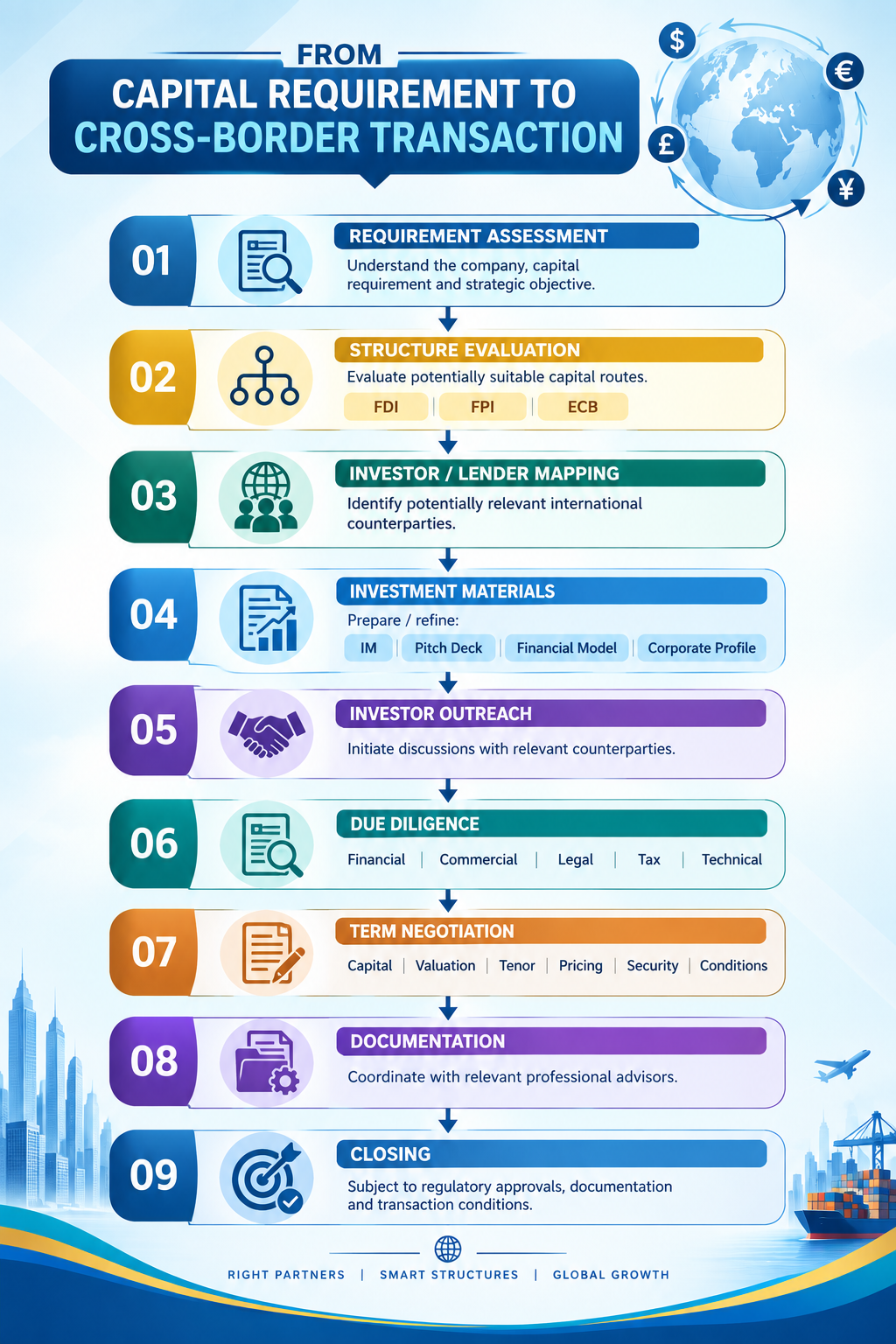
OUR PROCESS
Why Choose Us?
GLOBAL CAPITAL. LOCAL UNDERSTANDING. TRANSACTION FOCUS.
XYZ Arrow presents international presence across India, Middle East, Africa, UK, Europe, Australia/New Zealand, East Asia, Southeast Asia and North America.
Our team can assist with investor presentations, business profiles, project reports, financial models, valuation, cap-table preparation and exit-strategy considerations.
FDI + FPI + ECB + Equity + Debt + Strategic Capital.
Our team brings experience across corporate funding, investment banking, financial structuring and business advisory.
From initial assessment and funding strategy to coordination with potential financing institutions, we support the process through the relevant stages.
Frequently Asked Questions
FDI stands for Foreign Direct Investment and generally refers to foreign investment in an Indian entity/business that falls within the applicable direct-investment framework.
FPI stands for Foreign Portfolio Investor. It is the current regulatory terminology used by SEBI for eligible foreign portfolio investors investing in Indian securities.
“FII” is an older/common term. India’s current regulatory framework uses FPI — Foreign Portfolio Investor. The distinction is important when discussing current regulatory requirements.
ECB stands for External Commercial Borrowings and broadly refers to eligible cross-border borrowing by eligible Indian entities under the applicable RBI/FEMA framework.
FDI is equity/direct investment, whereas ECB is a form of eligible cross-border debt borrowing.
Potentially, subject to the applicable foreign-investment rules, sectoral conditions, entry route, pricing, reporting and other requirements.
Not necessarily. The economics depend on currency, interest rate, hedging, fees, tenor, security, lender requirements and the applicable regulatory conditions.
Potentially, depending on the business, sector, investor, ownership structure and applicable foreign-investment framework
Potentially, but the rules depend on the specific real-estate activity, structure and applicable conditions. The transaction should be reviewed against the current foreign-investment framework before proceeding.
Potentially, subject to the applicable sectoral, ownership, regulatory and other conditions.
here is no universal minimum FDI amount applicable to every transaction Requirements depend on the sector, structure and applicable rules.
There is no universal timeline. It depends on investor identification, due diligence, negotiations, valuation, documentation and regulatory/reporting requirements.
For an initial assessment, you can request:
- Company profile
- Certificate of incorporation
- Shareholding pattern
- Promoter profile
- Audited financial statements
- Latest management financials
- Business plan
- Financial projections
- Existing debt
- Proposed investment amount
- Proposed use of funds
- Valuation expectations
- Cap table
- Existing investors
- Major contracts
- Sector information
- Proposed transaction structure
For ECB discussions
Also consider:
- Existing foreign currency exposure
- Proposed borrowing amount
- Proposed tenor
- Proposed end-use
- Proposed lender profile
- Security requirements
- Repayment structure
- Currency requirements
Final requirements depend on the transaction and applicable regulations.
Important Disclaimer: XYZ Arrow provides financial, capital and transaction advisory support and does not independently guarantee any FDI, FPI or ECB transaction, investor commitment, financing approval or regulatory outcome. Any transaction is subject to applicable laws, regulations, eligibility conditions, investor/lender due diligence, commercial negotiations, documentation and approvals. Foreign investment and external borrowing requirements can vary by sector, entity, transaction structure and applicable rules. Clients should obtain appropriate legal, tax, regulatory and compliance advice before implementing a transaction.
READY TO EXPLORE GLOBAL CAPITAL?
Contact us
- +91-8260673300
- invest@xyzarrow.com
- Globally